Category: Blog

  • And slowly and surely…

    And slowly and surely…

    …they drew their plans against us!

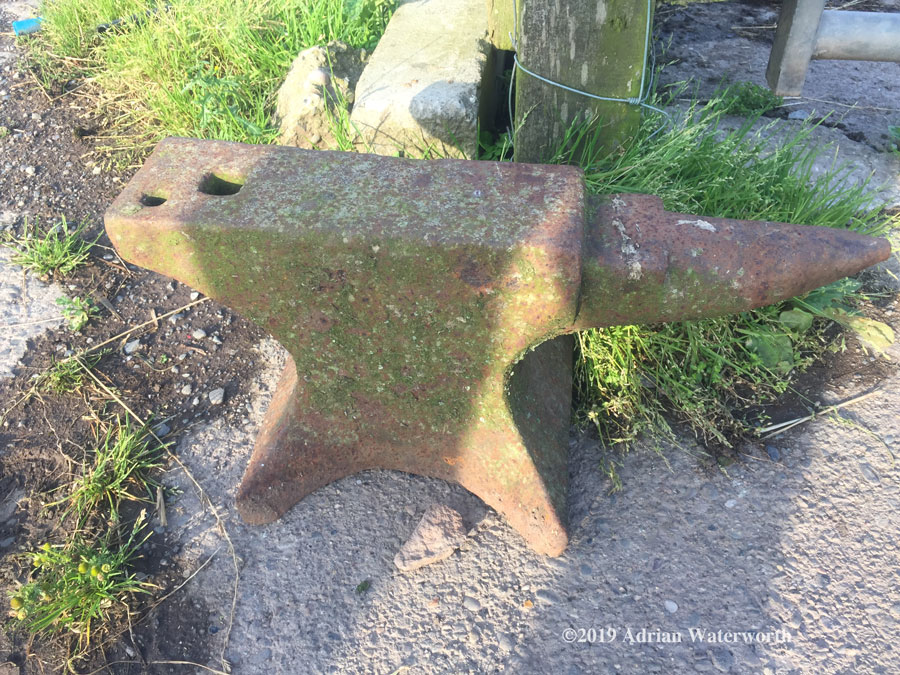
    No, Drummore has not been invaded by Martians! It is, however, inching closer to having a working smithy in the village once more. Thanks to Glenda, the old Drummore Smiddy now contains an anvil again. It’s a bit of a baby one (only weighs just over a hundredweight – or around 57kg in new money) and it’s getting on a bit in years, with a few dings here and there, but it’s solid enough and more than serviceable for my trainee blacksmithing purposes.

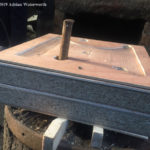
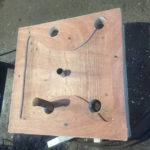
    I’ve actually had it for a few weeks now, but as you can see above, it needed a good clean up and a good going-over with rust remover/sealer first so that took a little while (in between doing all my other usual day-to-day things). It’s also considerably smaller than the original anvil that was here, so the existing stand (or, rather, stump – a fine old beast of a thing) was going to need building up in order to get the new anvil to around the right working height for me. Again, this has taken a little while, but I was fortunate that I had various offcuts of kitchen worktop and plywood lying around from when we had the new kitchen fitted last year. So, following a week or two of measuring and pondering, I came up with a plan to give the old anvil stump a bit of additional height.

    Using the hefty old spikes on the top of the stump as registration/anchor points, I created a thick sandwich of plywood and worktop sections. A final piece of plywood on the top – cut to match the rough shape of the base of the new anvil – provides some lateral stability, along with a short section of metal tube in the centre that will slot into a metal hole on the base of the anvil itself. Et voila!

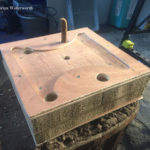
    Leaving aside the temporary softwood wedges that I used to level up the whole arrangement (and which will be getting replaced with something better in due course) I think the whole thing worked rather well. And the newly cleaned and rust-treated anvil fits beautifully, even if I say so myself.

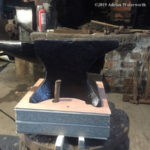
    The one remaining job on this is to anchor the anvil in place. The little cut-out recess that it sits inside and the metal insert in the centre will help to stop it sliding sideways, but there still needs to be something to stop it jumping a bit if I need to do any seriously heavy hammering. One option would be to create staples over the corners using coach bolts and bits of steel, but another option that is often used is to chain it down. I’ve already bought a length of suitable anchor chain (as used on small boats – not supertankers!) and will be wrapping that around the waist of the anvil and attaching it to hooks and adjustable shackles that I will drill into the sides of the stump. This will not only hold the anvil in place, but can also help mute its ring a little since, while most of this anvil isn’t too noisy, striking anything on the bick (a.k.a. the horn or, if you prefer, the pointy bit at one end) does tend to emit a surprisingly ear-piercing “Ting!” at the moment.

    And once that’s done, I’ll be firing up the forge! But that’s a story for another day…


  • Well…that’s embarrassing…

    Well…that’s embarrassing…

    I think I’ve just discovered a wonderful way to give the old ego a bit of a reality check.

    If you happen to have a blog (or other online vehicle where you discuss your daily life, thoughts, doings and wotnots) and you ever find yourself thinking that you might be getting a little full of yourself or that you would benefit from being brought down to earth a little, can I suggest going back and taking a look through all the stuff that you have posted in the past?

    In my case, it took a couple of hours. I originally started blogging years ago on Blogger.com (my old blog is probably still on there somewhere). I then moved everything on to WordPress, hosted on WordPress.com, and finally onto my own WordPress installation on my own server.

    In between the various technical changes and moves between hosting platforms, I blogged at random (and sometimes rather long) intervals, discussing the various things that were happening in my life at the time. As you do. I still have all of those old posts stored away in my database here, invisible to the outside world, but available for me to revisit and reconnect with my past self. Today, I thought that I’d take a wander through them all and see if any of them are worth reviving and putting on show once again – whether because they still hold some kind of relevance today or because they have some particular historical interest.

    Er…um…yes. A fascinating exercise indeed. There’s a couple of hours of my life that I won’t get back. What I found during this bit of introspective blog archaeology is probably best summed up as follows:

    • About 30% relating to events that were relevant (and, in some cases, important) at the time, but which are utterly irrelevant today
    • About 20% relating to my work in the various art and craft businesses that Glenda and I have run over the years (largely irrelevant today, so can be combined with the above)
    • Maybe 20% relating to personal events that I’d rather not revisit any more, thank you very much (relevant, but painful or sad)
    • At least 20% being apologies for not blogging more regularly, comments on how long it was since I last blogged or that I was changing blog theme/host/software/underwear/whatever once again
    • Which leaves maybe 10% that are what I might call decent content that might be worth revisiting at some point in the future.

    The other thing that I discovered (and which I always knew really) was that my writing style was atrocious. Well, maybe not atrocious, but definitely long-winded, excessively complex and prone to extraneous verbiage. (See what I mean? If you think I’m bad for that sort of thing nowadays, you should see what I was like a decade ago!)

    At the end of the whole process, I left my desk feeling suitably humbled, more than a little embarrassed at my younger self and promising in my heart of hearts to be a better person and to try to write more interesting and worthwhile things in the future. Oh, and to keep a closer eye on my writing style while I’m at it. (Not that this post is holding out too much promise on that front, but we’ve all got to start somewhere.)

    I may still wheel out some of that “decent 10%” of old posts in the future if I think it’s worth doing, but I think the other 90% will be remaining locked away. (And you should probably thank me for that.)


  • Between the sea and the sky…

    Between the sea and the sky…

    Very occasionally, people ask me why I chose to move to Scotland (generally) and why I chose to move to the rather remote end of Galloway (specifically). Well, a full discussion of the various personal, political, social, economic and other assorted reasons could take up a few pages and bore all but the most dedicated reader to tears I suspect. However, what it all boils down to in the end is that Glenda and I really wanted to live somewhere beautiful, close to the sea and on the west side of the country. And we like Scotland. We considered a few different places (Kintyre, further north into the Highlands and Islands, etc.) but finally, like Richard Hannay in The Thirty-Nine Steps, we “fixed on Galloway as the best place to go.”

    Of course, there are sometimes challenges living in rural and remote areas, but we’re not really too far off the beaten track here compared to many other places. And, in return for being here, we get things like this…

    This is West Tarbet bay. It’s maybe a mile or so from the very south-western tip of Scotland, where the Mull of Galloway lighthouse stands on the cliff-top, looking out over the Irish Sea. At this point, the land narrows, squeezed between East Tarbet bay on one side and West Tarbet bay on the other, the two almost cutting off the Mull of Galloway altogether. At high tide, an accomplished cricketer or baseball player with a good arm, standing on the road above the two bays, could probably throw balls into the Irish Sea to the west and Luce Bay to the east. It is a breathtakingly beautiful place and if I feel troubled or weary, I only need to go to West Tarbet – or any of the other amazing spots on the Galloway coastline – and live and breathe for a while in that magical space between the sea and the sky.

  • Let there be books…

    Let there be books…

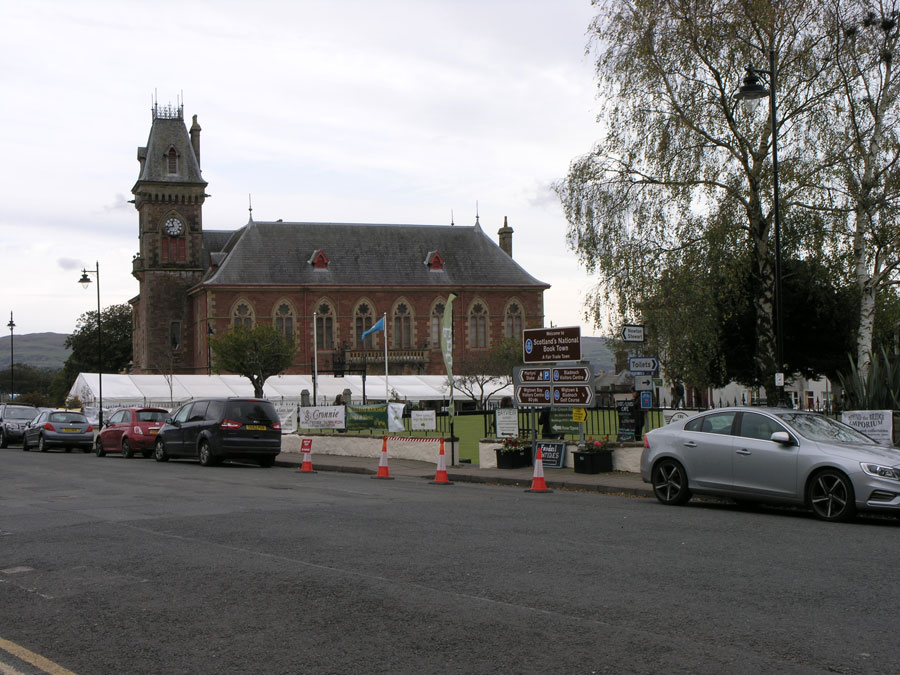
    South-West Scotland has much to recommend it. First off, it’s part of Scotland which is, itself, no bad thing at all. Second, it has some beautiful countryside, both along the coast (of which there is quite a lot) and inland. Third? Well, there are countless other things I could probably list, but if you’re a bookish sort like me, one of the major highlights is Wigtown.

    Situated on the Machars peninsula, around 50 miles west of Dumfries, Wigtown is Scotland’s Book Town. Sort of a Scottish equivalent of Hay-on-Wye, if you will. It has numerous second-hand and antiquarian bookshops, some rather nice bits and bobs of architecture, a long and interesting history and, at this time of year, it becomes a thronging metropolis of authors, publishers, editors, critics and literary bods of every conceivable stripe. For ten days, the Wigtown Book Festival bursts into life and makes the whole town even more bookish than usual (if that is possible). There are talks, tours, workshops, literary pub quizzes, concerts and all manner of entertainments (usually related to books in some fashion, of course). As well as a packed programme of events for adults, there is also a thriving young-adult side to the festival and even stuff for the kiddies. All in all, it’s a wonderful feature of the local calendar and always has something interesting to offer.

    It usually falls over the last weekend of September and first week of October, so this year’s festival began last Friday (27th) and runs until this coming Sunday (6th). If you’re anything like me, you would find it very easy to lose a full ten days of your life to it, attending events all day, every day from breakfast until supper time. You’d also probably find that – even though the various talks and other sessions are very reasonably priced (and, in some cases, completely free) – you’d put quite a dent in your bank account by the end of it all. So, unless you happen to be blessed with a healthy supply of spare time and spare cash, it usually makes sense to do a bit of picking and choosing when it comes to what you want to attend.

    This year, I chose half a dozen sessions to attend and have enjoyed learning more about:

    All of them were interesting, all of them taught me some things I didn’t know and all of them were entertaining. I would recommend any of the above books which are available from all good booksellers (including the half-ton gorilla in the room, Amazon) but I’ve provided links to them on The Book People. This is largely out of respect for Shaun Bythell, proprietor of The Book Shop in Wigtown, now a best-selling author himself, an all round good egg (don’t tell him I said that!) and a man who, as an independent book seller, has a love-hate (well, mainly hate really) relationship with Amazon. (Although I do confess to using Amazon for all sorts of stuff – very useful when living somewhere a bit remote – I wouldn’t even dream of pointing anyone in the direction of Amazon in this particular post!)

    So if you’re a bookish type and are looking for your next literary festival fix, try a jaunt out into the wilds of south-west Scotland. You might be surprised what you find there! You’ve only got a couple of days before it wraps up again for this year, but it’ll be coming around again at the end of next September and I’m prepared to bet there’ll be more good, fun and fascinating stuff to see.


  • Underneath the spreading chestnut tree…

    Underneath the spreading chestnut tree…

    No, this isn’t going to be a post about old nursery-rhyme songs, Winston Smith, Mr Charrington and 1984, apposite as that might be when it comes to current times and trends in UK and US politics. Instead, it’s a reference to a poem by Longfellow, entitled “The Village Blacksmith”, the first verse of which runs:

    Under a spreading chestnut tree

    The village smithy stands;

    The smith, a mighty man is he,

    With large and sinewy hands;

    And the muscles of his brawny arms

    Are strong as iron bands.

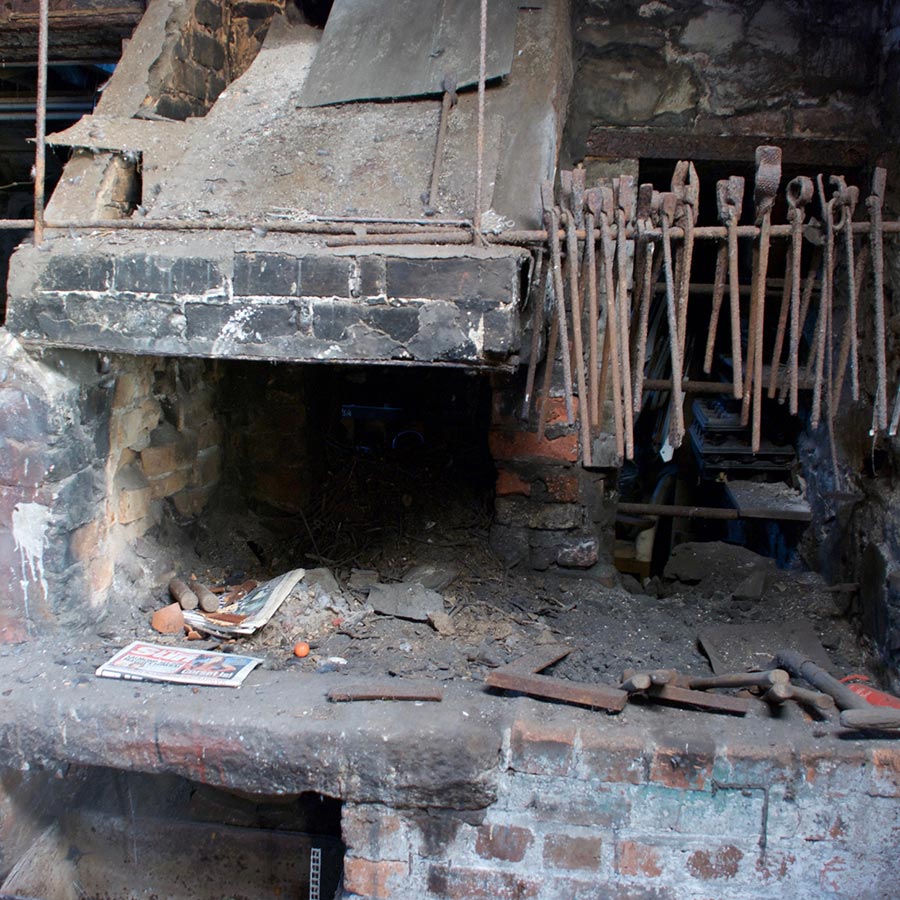
    Now, I suppose I could pass as a mighty man (in a certain light) and my hands are large-ish and somewhat sinewy. I’m not too sure about my brawny arm muscles being strong as iron bands (not yet anyway) but I suppose two out of three isn’t bad. More importantly, there is a spreading chestnut tree outside and, under it, you will indeed find the village smithy. Our current home was the “Drummore Smiddy” for probably the best part of a century, although the forge fell into disuse around twenty years ago. Almost everything is still there though (but for the anvil) and, ever since moving in last year, I have been increasingly fascinated, tempted and inspired by looking at the old forge and the assortment of dusty and rusting tools and equipment around it.

    I’ve always been fascinated by machinery and devices made from metal and I definitely have more of an affinity with metalwork than, say, woodwork or stonework. Under the circumstances (and with new and exciting creative ideas buzzing around in my head like never before) it made sense for me to find a blacksmithing course where I could learn some of the basics and not only find out whether I really liked it but also discover whether or not I’d be any good at it.

    Enter a great guy by the name of Andy McKenzie of Feather Forge in Glasgow. I have now done two one-day training courses at Feather Forge, as well as attending a five-day intensive workshop that he held earlier this year up near Lochgoilhead. So far, I have learnt the basics of forge and fire management, hammer technique, a bit of tool-making and the various other basic skills required around the blacksmith’s forge. And I absolutely love it to bits. It’s exciting and interesting and inspiring and just immense fun! I wish I’d done it years ago and – as I say in my About page – I finally know what I want to be when I grow up.

    Next step is to bring Drummore Smiddy (or Finefiew Forge as it’s going to be called) back to life. It’s going to take a lot of time and effort, possibly a fair bit of cash and I’m going to have to keep developing and honing my skills along the way. Wish me luck!


  • Always read the small print…

    Always read the small print…

    It’s a good rule of thumb, reading the small print. Taking out a mortgage? Signing the employment contract for your new, executive suite, highly-paid job? Signing your multi-million pound major label record deal or assigning the Hollywood film rights to your best selling novel? All these kind of situations lend themselves to a careful scrutinisation of the reams of vanishingly small and convoluted legalese that is invariably to be found in such circumstances.

    Buying a tube of bathroom sealant? Not so much. Or so I foolishly thought. Let this be a cautionary tale…

    There is a shower in the bathroom here. A bog-standard cubicle with a simple shower unit, the sort of thing we all probably recognise. And, like many showers, it was looking a bit grubby and a bit tired around the shower tray, so yours truly thought “Aha! I can fix this. I shall remove the grotty old silicone sealant and replace it with some shiny, new silicone sealant, thus making everything look cleaner and preventing any unexpected leaks around the place.” What could be simpler? So off I trot to a nearby hardware emporium to acquire a tube of the relevant gunk. Having examined the various options, including some eye-wateringly expensive versions that were, basically, the same as all the others but cost twice as much because they had an “Evo-Stik” logo on them, I settled for a cheaper (but still branded) variant that appeared to tick all the right boxes.

    • Bath and Kitchen Sealant? Check! (That’s its name, in big letters on the front.)
    • For sealing around baths, showers, basins and kitchen worktops? Check! (It also says this on the front.)
    • White? Check!
    • Mould resistant? Check!
    • Considerably cheaper than buying anything with an Evo-Stik logo on the front? Oh yes!

    The job, as they say, is a good ‘un. So I returned home with my prize and, yestereve, set to work.

    An hour or so later, the area around the shower tray was suitably cleaned and prepared, with the tatty old sealant removed and everything cleaned and dried ready for the new stuff. A slightly tiresome job that entailed kneeling on the bathroom floor for some time and performing various gymnastic contortions to reach into all four corners of the shower tray, but a worthwhile effort nevertheless. I then took my trusty Stanley knife and opened the new tube of sealant. “Interesting…” I thought. It didn’t have quite the overpowering vinegary pong that I normally associate with such products and it almost looked more like a glossy version of decorator’s caulk, but I tested a bit of it on my finger and all seemed well. “Perhaps it’s just a newer, lower-odour formula?” I wondered.

    In any case, proceeding with my customary, vim, vigour, gusto, more kneeling and more gymnastical contortioning, I applied a (fairly) neat bead of the new sealant to all the edges, corners, nooks, crannies and other sundry spaces that needed it. Another hour or so later and all looked clean and shiny and new and, although I was feeling a bit hot, bothered, and knackered by this point (from all the kneeling and waddling around the bathroom floor like some demented Toulouse-Lautrec impersonator), I was feeling rather pleased with myself and proud of my efforts.

    While cleaning up and putting everything away, I happened to glance at the reams of teeny-tiny print on the rear of the tube of sealant I had just used. As many of you may know, silicone sealant and similar products, largely tend to cure within around twenty four hours – some of the fast-curing versions even sooner. So I was expecting the same here, but I was mistaken. At the bottom of one paragraph, I espied the following:

    For full cure, allow 3 to 5 days, dependent on thickness, ambient temperature and humidity. Do not expose to water until fully cured (see Limitations).

    Three to five days? Seventy-two to one-hundred-and-twenty hours? Three to five times the entire lifespan of the average Mayfly? Say what? I don’t think I’ve ever encountered a sealant that took so long to cure. More importantly, I don’t fancy going without a shower until Saturday night and I’m fairly sure that anyone who has to spend any length of time in my company would heartily concur with that sentiment. But it gets better. That “Limitations” paragraph they mention? Buried in the heart of it, we find:

    Do not use on shower cubicles where a higher degree of movement/flexibility is usually required – use General Purpose Silicone or Showerproof Bathroom Silicone.

    Er…chaps? This would be a tube of “Bath and Kitchen Sealant” would it not? I’d just like to check, because that is what the big words do actually say in the product name on the front of the tube. Moreover, does it not, in fact, also say “For sealing around baths, showers, basins and kitchen worktops”? Admittedly in a slightly smaller font, but also on the front of the tube and please do note the word “showers” in there. Given that these things are, pretty much, inarguable (as I sit here looking at the offending tube and reading the relevant words) how the bloody hell does your product then turn out to be unsuitable for shower cubicles? Seriously? At the very least, change the wording on the front you inexcusable cockwombles!!

    I have just spent another hour in the bathroom, Toulouse-Lautrec style, removing all the sealant that I applied last night. And yes, it looks like the three to five day cure time is about right, as after about twelve hours, much of it was still putty-like and only slightly more solid than it was when it first emerged from the tube.

    Shortly, I shall wend my way to another hardware emporium, there to buy a new tube of proper, real, silicone sealant that actually does what it says and cures in less than a week. If I get the fast curing version and I’m lucky, I might even be able to take a shower in the morning.

    In any case, I shall definitely be reading the small print…