It’s a good rule of thumb, reading the small print. Taking out a mortgage? Signing the employment contract for your new, executive suite, highly-paid job? Signing your multi-million pound major label record deal or assigning the Hollywood film rights to your best selling novel? All these kind of situations lend themselves to a careful scrutinisation of the reams of vanishingly small and convoluted legalese that is invariably to be found in such circumstances.
Buying a tube of bathroom sealant? Not so much. Or so I foolishly thought. Let this be a cautionary tale…
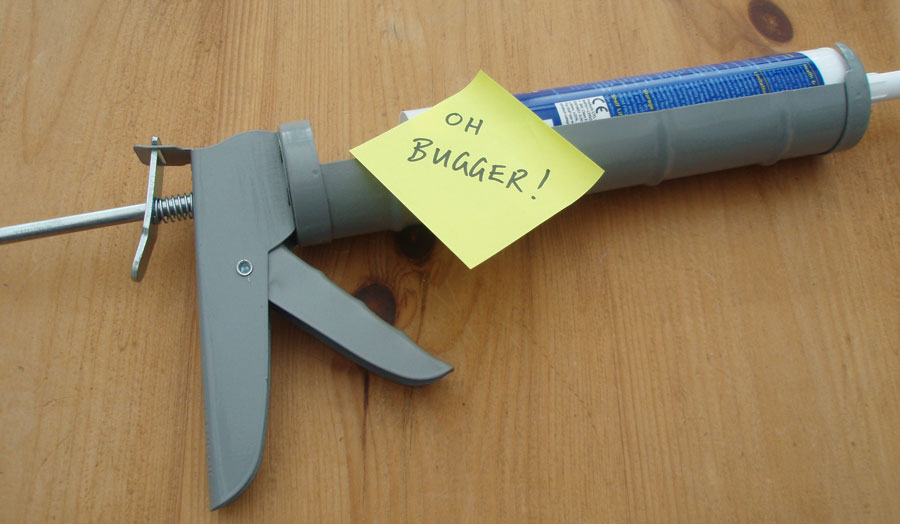
There is a shower in the bathroom here. A bog-standard cubicle with a simple shower unit, the sort of thing we all probably recognise. And, like many showers, it was looking a bit grubby and a bit tired around the shower tray, so yours truly thought “Aha! I can fix this. I shall remove the grotty old silicone sealant and replace it with some shiny, new silicone sealant, thus making everything look cleaner and preventing any unexpected leaks around the place.” What could be simpler? So off I trot to a nearby hardware emporium to acquire a tube of the relevant gunk. Having examined the various options, including some eye-wateringly expensive versions that were, basically, the same as all the others but cost twice as much because they had an “Evo-Stik” logo on them, I settled for a cheaper (but still branded) variant that appeared to tick all the right boxes.
- Bath and Kitchen Sealant? Check! (That’s its name, in big letters on the front.)
- For sealing around baths, showers, basins and kitchen worktops? Check! (It also says this on the front.)
- White? Check!
- Mould resistant? Check!
- Considerably cheaper than buying anything with an Evo-Stik logo on the front? Oh yes!
The job, as they say, is a good ‘un. So I returned home with my prize and, yestereve, set to work.
An hour or so later, the area around the shower tray was suitably cleaned and prepared, with the tatty old sealant removed and everything cleaned and dried ready for the new stuff. A slightly tiresome job that entailed kneeling on the bathroom floor for some time and performing various gymnastic contortions to reach into all four corners of the shower tray, but a worthwhile effort nevertheless. I then took my trusty Stanley knife and opened the new tube of sealant. “Interesting…” I thought. It didn’t have quite the overpowering vinegary pong that I normally associate with such products and it almost looked more like a glossy version of decorator’s caulk, but I tested a bit of it on my finger and all seemed well. “Perhaps it’s just a newer, lower-odour formula?” I wondered.
In any case, proceeding with my customary, vim, vigour, gusto, more kneeling and more gymnastical contortioning, I applied a (fairly) neat bead of the new sealant to all the edges, corners, nooks, crannies and other sundry spaces that needed it. Another hour or so later and all looked clean and shiny and new and, although I was feeling a bit hot, bothered, and knackered by this point (from all the kneeling and waddling around the bathroom floor like some demented Toulouse-Lautrec impersonator), I was feeling rather pleased with myself and proud of my efforts.
While cleaning up and putting everything away, I happened to glance at the reams of teeny-tiny print on the rear of the tube of sealant I had just used. As many of you may know, silicone sealant and similar products, largely tend to cure within around twenty four hours – some of the fast-curing versions even sooner. So I was expecting the same here, but I was mistaken. At the bottom of one paragraph, I espied the following:
For full cure, allow 3 to 5 days, dependent on thickness, ambient temperature and humidity. Do not expose to water until fully cured (see Limitations).
Three to five days? Seventy-two to one-hundred-and-twenty hours? Three to five times the entire lifespan of the average Mayfly? Say what? I don’t think I’ve ever encountered a sealant that took so long to cure. More importantly, I don’t fancy going without a shower until Saturday night and I’m fairly sure that anyone who has to spend any length of time in my company would heartily concur with that sentiment. But it gets better. That “Limitations” paragraph they mention? Buried in the heart of it, we find:
Do not use on shower cubicles where a higher degree of movement/flexibility is usually required – use General Purpose Silicone or Showerproof Bathroom Silicone.
Er…chaps? This would be a tube of “Bath and Kitchen Sealant” would it not? I’d just like to check, because that is what the big words do actually say in the product name on the front of the tube. Moreover, does it not, in fact, also say “For sealing around baths, showers, basins and kitchen worktops”? Admittedly in a slightly smaller font, but also on the front of the tube and please do note the word “showers” in there. Given that these things are, pretty much, inarguable (as I sit here looking at the offending tube and reading the relevant words) how the bloody hell does your product then turn out to be unsuitable for shower cubicles? Seriously? At the very least, change the wording on the front you inexcusable cockwombles!!
I have just spent another hour in the bathroom, Toulouse-Lautrec style, removing all the sealant that I applied last night. And yes, it looks like the three to five day cure time is about right, as after about twelve hours, much of it was still putty-like and only slightly more solid than it was when it first emerged from the tube.
Shortly, I shall wend my way to another hardware emporium, there to buy a new tube of proper, real, silicone sealant that actually does what it says and cures in less than a week. If I get the fast curing version and I’m lucky, I might even be able to take a shower in the morning.
In any case, I shall definitely be reading the small print…